Hip pain that radiates down the leg: how to tell if it’s your hip or your spine
Where exactly it hurts gives you a lot of clues. Pain from the groin to the thigh, on the outside of the hip or from the buttock down to the foot usually has a different cause.

Hip pain that radiates down the leg is very common, but it doesn’t always come from the hip. The same discomfort can come from the joint itself, from the tissues around it or from a nerve that starts in the spine. The most useful clue is where the pain starts and how far down it goes.
If the pain is in the groin and goes down the front of the thigh, it usually comes from the hip joint, as in osteoarthritis. If it’s on the bony point on the outside of the hip and runs down the side of the thigh, it may be bursitis. If it starts in the lower back or buttock, travels down the back of the leg to the calf or foot and causes tingling, it usually comes from the spine (sciatica). Only an exam can confirm it.
Where it hurts and what it can be
- Groin and front of the thigh, sometimes down to the knee: it usually comes from the hip joint, for example osteoarthritis. It gets worse when you get up in the morning, after sitting and when you walk.
- Bony point on the outside of the hip and side of the thigh: it may be trochanteric bursitis. It gets worse when you lie on that side, get up from a chair or climb stairs.
- Lower back or buttock, back of the thigh, calf and sole of the foot: it’s usually sciatica, the nerve that comes from the spine. It gets worse after sitting or standing for a long time, and when you cough or sneeze.
This list is a guide, not a diagnosis. Sometimes there are two causes at once, for example hip osteoarthritis and a spine problem.
Groin and thigh: when the joint hurts
When the problem is in the joint itself, the pain is often felt in the groin and can travel down the thigh and reach the knee. That’s why some people see a doctor for knee pain when the source is actually the hip.
The most common cause in adults is hip osteoarthritis, wear of the cartilage in the joint. It usually causes:
- Stiffness in the morning or after sitting for a while.
- Pain that gets worse with activity and, over time, also shows up at rest or at night.
- Less motion: walking, bending down or bending the leg gets harder.
- A limp, because the hip no longer moves fully.
- Grinding or a feeling that the hip catches.
Treatment starts without surgery: changing the activities that strain it most, low-impact exercise such as swimming or cycling, losing weight if needed, physical therapy and, as prescribed by your doctor, medication or an injection. When the pain becomes disabling and doesn’t respond to these measures, a hip replacement is considered. Hip and knee reconstruction is Dr. López’s fellowship specialty.
Outside the hip: trochanteric bursitis
If the pain is on the bony point you can feel on the outside of the hip and runs down the side of the thigh, it may be trochanteric bursitis: inflammation of a small sac that reduces friction between the bone and the tissues that pass over it.
At first it’s usually a sharp, intense pain, and over time it becomes a wider ache. It gets worse when you lie on that side at night, get up from a chair after sitting, walk a lot, climb stairs or squat. It’s more common in middle-aged or older women, although anyone can get it.
It’s almost always treated without surgery: cutting back on the activities that trigger it, physical therapy to stretch and strengthen and, in some cases, an injection. Injections have a limit, because repeating them too often can damage the surrounding tissues.
Buttock to foot: when it comes from the spine
If the pain starts in the lower back or the buttock and travels down the back of the thigh, the calf and even the sole of the foot, it most likely isn’t coming from the hip but from the sciatic nerve, which starts in the lower spine. Sciatica isn’t a disease in itself: it’s a sign that something is pressing on that nerve, such as a herniated disc or a narrowing of the spinal canal.
Clues that point to the spine:
- The pain is usually on one side only.
- There’s tingling, burning or numbness.
- The leg feels weak or the foot drags when you walk.
- It gets worse after sitting or standing for a long time, or when you cough or sneeze.
Back pain and sciatica are also treated in orthopedics and trauma. What matters is finding exactly where the pain comes from, so the right cause gets treated.
Not sure where your pain comes from?Your consultation includes an exam of the hip and the spine to find the source.
Book a consultationWhich tests are ordered
- Physical exam. Where it hurts when pressed, how the hip moves, how you walk, and a check of the spine and of the strength and sensation in the leg.
- X-ray. It’s the first test for the joint: it shows whether the space between the bones is narrowing and whether there are osteophytes, small bony spurs.
- MRI or CT scan. Ordered in some cases, to look at the bone, the soft tissues or the spine in more detail.
When to go to the ER
- After a fall you have severe pain or can’t put weight on your leg or move your hip.
- The hip or leg looks deformed, or there’s a large bruise or bleeding.
- You lose control of your bladder or bowels.
- You have weakness or numbness in the buttocks, thighs or legs.
- The pain comes with a fever.
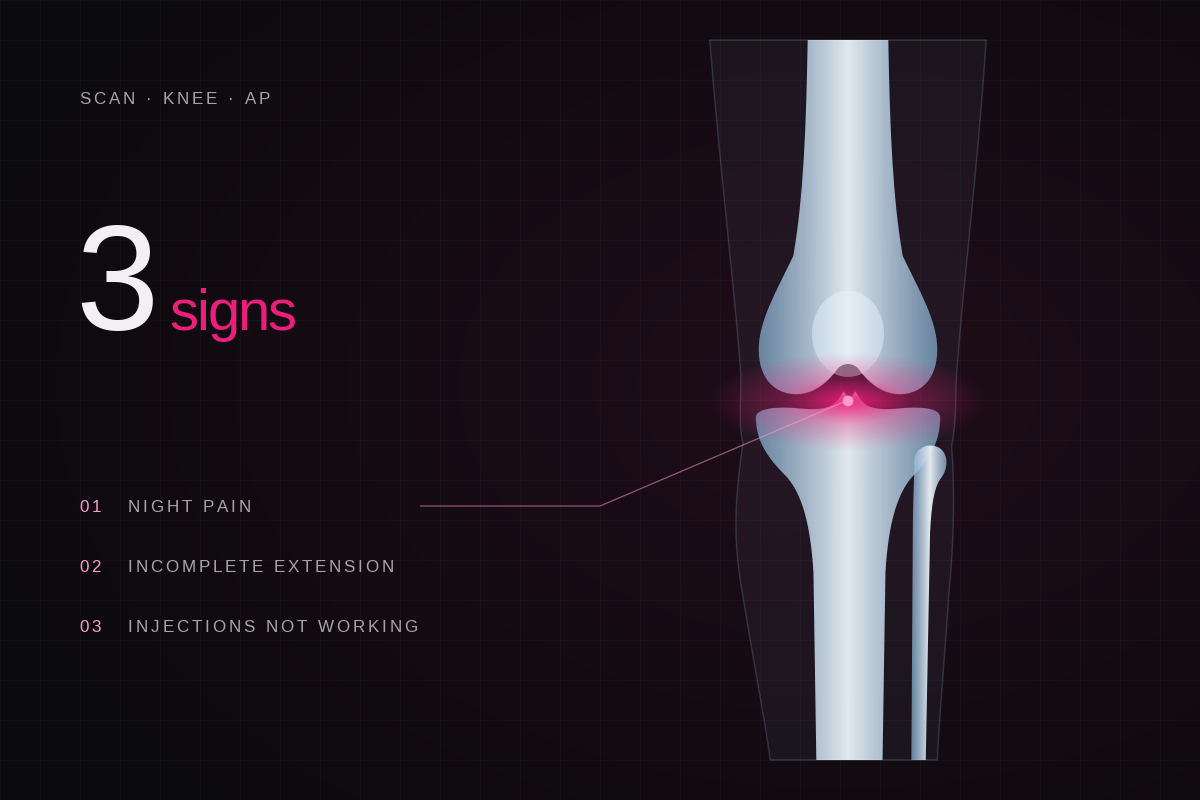
If the pain lasts more than a week of home care, if you limp or if walking or climbing stairs is hard, book a consultation in Tijuana. And if your knee is what hurts most, read 3 signs your knee needs to be checked.
Frequently asked questions
How can I tell if it’s hip pain or sciatica?
Location helps a lot. Hip joint pain is usually in the groin and the front of the thigh. Sciatica usually starts in the lower back or buttock, travels down the back of the leg to the calf or foot and causes tingling. Sometimes both are present, which is why an exam is worth it.
Why does my hip hurt at night?
If it hurts when you lie on that side, it may be bursitis on the outside of the hip. If the pain shows up at rest or wakes you up even when you’re not lying on it, it may be advanced wear of the joint. Either way, it’s worth getting checked.
My knee hurts. Could it be coming from my hip?
Yes. Pain from the hip joint can be felt in the thigh and even in the knee. If your knee hurts and the cause isn’t found when it’s examined, the orthopedic surgeon also examines the hip.
Which specialist treats hip pain?
An orthopedic surgeon. Dr. Mariana López has fellowship training in hip and knee reconstruction, and during the consultation she also checks the spine to rule out that the pain comes from there.
Sources
- MedlinePlus Medical Encyclopedia. Hip pain.
- American Academy of Orthopaedic Surgeons (AAOS), OrthoInfo. Osteoarthritis of the Hip.
- American Academy of Orthopaedic Surgeons (AAOS), OrthoInfo. Hip Bursitis.
- MedlinePlus Medical Encyclopedia. Sciatica.
Dr. Mariana López Martínez
Dr. Mariana López Martínez is an orthopedic and trauma surgeon with fellowship training in hip and knee reconstruction from the Universidad de Monterrey at Swiss Hospital. She completed her residency at IMSS UMAE 21 in Monterrey and sees patients in Tijuana, in English and Spanish.
Medical license 11678865 · Specialty license 14090312
This article is for information only and doesn’t replace a medical consultation. If you have pain or questions about your case, book a consultation.