At what age should you have knee surgery? The answer isn’t a number
There’s no set age for knee surgery. What decides is the stage of wear, how much it hurts and what you’ve stopped doing.

"At what age should I have knee surgery?" is one of the most common questions at the office, and the short answer is that there is no set age. The American Academy of Orthopaedic Surgeons (AAOS) notes that there are no absolute age or weight restrictions for total knee replacement, and that the recommendation is based on the patient’s pain and disability, not their years. What does matter is the stage of wear and how much it limits you.
There’s no set age for knee surgery. In the United States the average age is approximately 65 to 67, but the decision depends on the degree of wear on the X-ray, your pain and how much it limits your daily life. Some young patients need it, and some older patients don’t.
Why age isn’t the criterion
A knee replacement isn’t indicated because of a certain age; it’s indicated when joint damage, pain and loss of function justify surgery.
A knee doesn’t wear out because of the years it has, but because of what it has carried. Two people the same age can have very different knees. These factors matter more than your date of birth:
- Previous injuries to the meniscus or ligaments, or fractures near the knee, even if they happened many years ago.
- Body weight, which increases the load on the joint with every step.
- Work and activity: long days on your feet, carrying weight and high-impact sports.
- Leg alignment: bowed or knock-knee legs put more load on one side of the knee.
- Inflammatory diseases such as rheumatoid arthritis, and family history.
The stages of knee wear
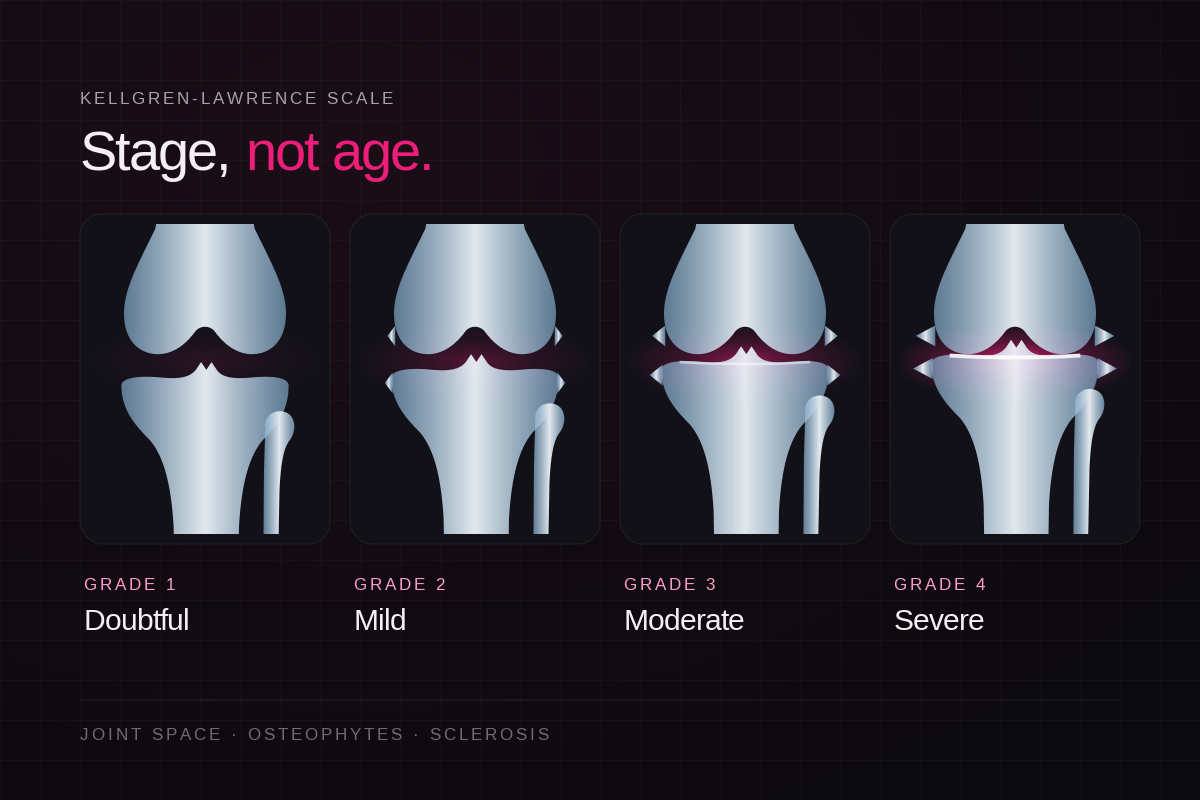
To describe how advanced osteoarthritis is on an X-ray, orthopedic surgeons often use the Kellgren-Lawrence scale, published in 1957 and still in use today. It measures three things: the space between the bones, osteophytes (small bony spurs that form at the edges) and sclerosis (denser bone under the cartilage).
| Grade | What the X-ray shows | How it’s described |
|---|---|---|
| 0 | No signs of osteoarthritis. | Normal knee |
| 1 | Possible small osteophyte; normal or doubtful joint space. | Doubtful |
| 2 | Clear osteophytes; possible narrowing of the space. | Mild |
| 3 | Several osteophytes, clear narrowing, some sclerosis and possible deformity. | Moderate |
| 4 | Large osteophytes, marked narrowing, significant sclerosis and deformity. | Severe |
The X-ray isn’t everything. Some people have grade 3 and little pain, and others have grade 2 and a lot of pain. That’s why the decision combines the image with what’s happening in your daily life.
What’s done at each stage
In early stages (grades 1 and 2), treatment is usually exercise, physical therapy, weight control and pain medication. In intermediate stages, injections, physical therapy or changes to your exercise routine can be added, along with comfortable shoes to reduce impact. When wear is advanced (grades 3 and 4) and the pain can no longer be controlled, surgery is considered: a partial replacement in the ideal candidate or a total knee replacement.
What really decides whether surgery makes sense
- Pain that can’t be controlled with medication, physical therapy or injections.
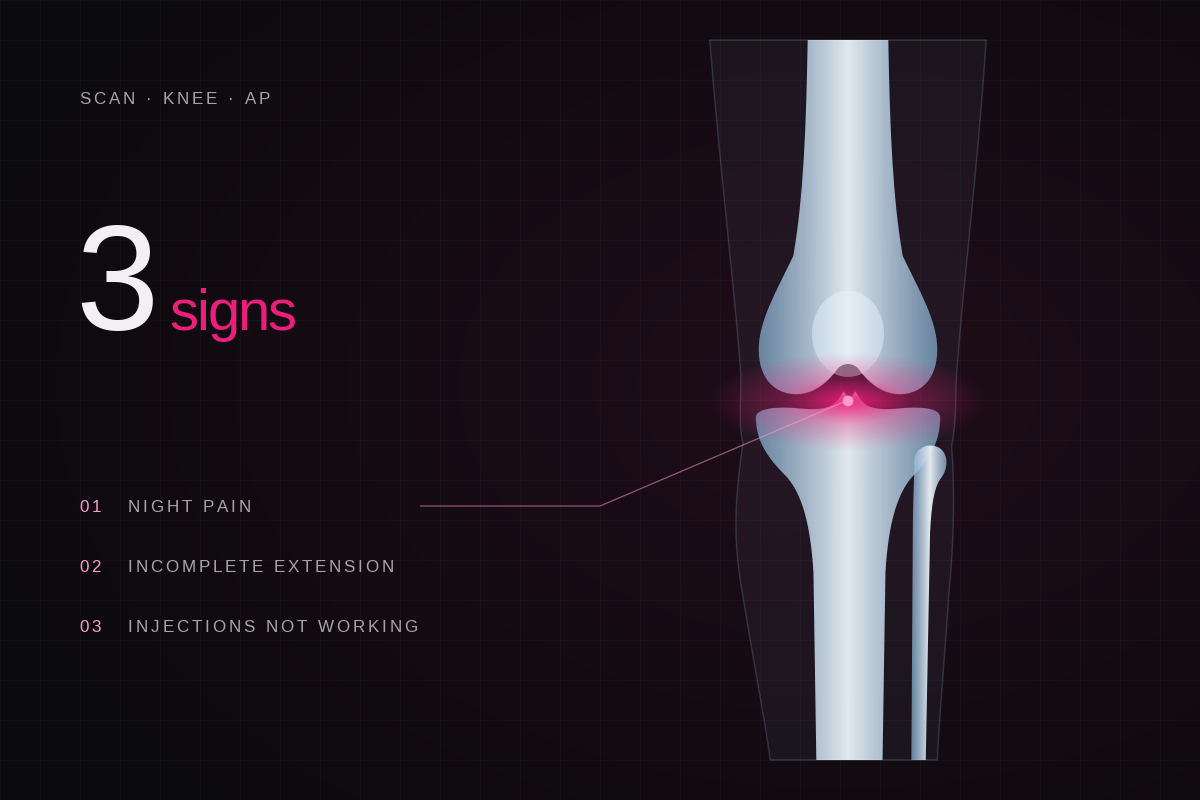
- Pain at rest or at night. We explain it in 3 signs your knee needs a consultation.
- Loss of motion or worsening deformity.
- What you’ve stopped doing: climbing stairs, going to the market, walking with your grandchildren, sleeping through the night.
- Your overall health, which is checked before any surgery.
A practical tip: before your visit, write a list of the activities you’ve been giving up because of your knee. That list is worth as much as the X-ray.
Want to know what stage your knee is in?Bring your X-rays, even if they’re old.
Book a consultationWhat if I’m young? What if I’m older?
Under 50
Knee replacements last many years, but a young, active person may need a revision in the future. That’s why other options are tried first. Even so, the AAOS points out that knee replacement has been done successfully at all ages: if the wear is severe and the pain is disabling, surgery may be the best decision.
Over 75
Age alone doesn’t rule out surgery. What’s checked is your overall health: heart, lungs, and diabetes and blood pressure under control. That review happens at the evaluation before surgery.
Waiting too long also has a cost
Putting off surgery that’s already indicated doesn’t make it easier. Over time, pain makes you move less, your thigh muscles weaken and your knee can lose motion. In some cases that makes recovery slower. The best way to decide is with information: what stage your knee is in today and what options you have.
Frequently asked questions
What is the average age for a knee replacement?
There is no minimum age and no “ideal age.” According to the American Association of Hip and Knee Surgeons (AAHKS), the indication is based mainly on pain, functional limitation, joint damage and failure of conservative treatment, more than on age, and the trend has been to operate earlier when the disease significantly limits the patient’s active life. For reference, the average age in the United States is approximately 65 to 67. Even so, today it’s reasonable to recommend a replacement in patients aged 50 to 60, and even younger, when there is advanced symptomatic osteoarthritis and quality of life is significantly affected. The U.S. AJRR registry includes more than 4.4 million hip and knee surgeries, which makes it one of the main references. And the old idea of “waiting until 65 or 70” has lost weight because modern implants last longer.
Can you have a knee replacement at 40?
Yes, in selected cases. If the wear is severe, for example after an injury or from inflammatory arthritis, and other options no longer work, a replacement may be the best option even in young people. It’s discussed in detail because an active person may need a revision of the replacement years later.
Can an 80-year-old have knee surgery?
Yes. Age alone doesn’t rule it out. What’s checked is the patient’s overall health, such as the heart, lungs and control of diabetes or blood pressure, at an evaluation before surgery. Many older people regain independence after a replacement.
Can knee wear be reversed?
Worn cartilage doesn’t significantly regenerate on its own. But pain and function can improve a lot with exercise, physical therapy, weight control and other treatments, especially in early stages. That’s why it’s worth having your knee checked before the wear advances.
Sources
- American Academy of Orthopaedic Surgeons (AAOS), OrthoInfo. Total Knee Replacement.
- American Academy of Orthopaedic Surgeons (AAOS). American Joint Replacement Registry (AJRR), Annual Report 2025.
- MedlinePlus. Osteoarthritis.
- Kellgren JH, Lawrence JS. Radiological assessment of osteo-arthrosis. Annals of the Rheumatic Diseases. 1957;16(4):494-502.
Dr. Mariana López Martínez
Dr. Mariana López Martínez is an orthopedic and trauma surgeon with fellowship training in hip and knee reconstruction from the Universidad de Monterrey at Swiss Hospital. She completed her residency at IMSS UMAE 21 in Monterrey and sees patients in Tijuana, in English and Spanish.
Medical license 11678865 · Specialty license 14090312
This article is for information only and doesn’t replace a medical consultation. If you have pain or questions about your case, book a consultation.